


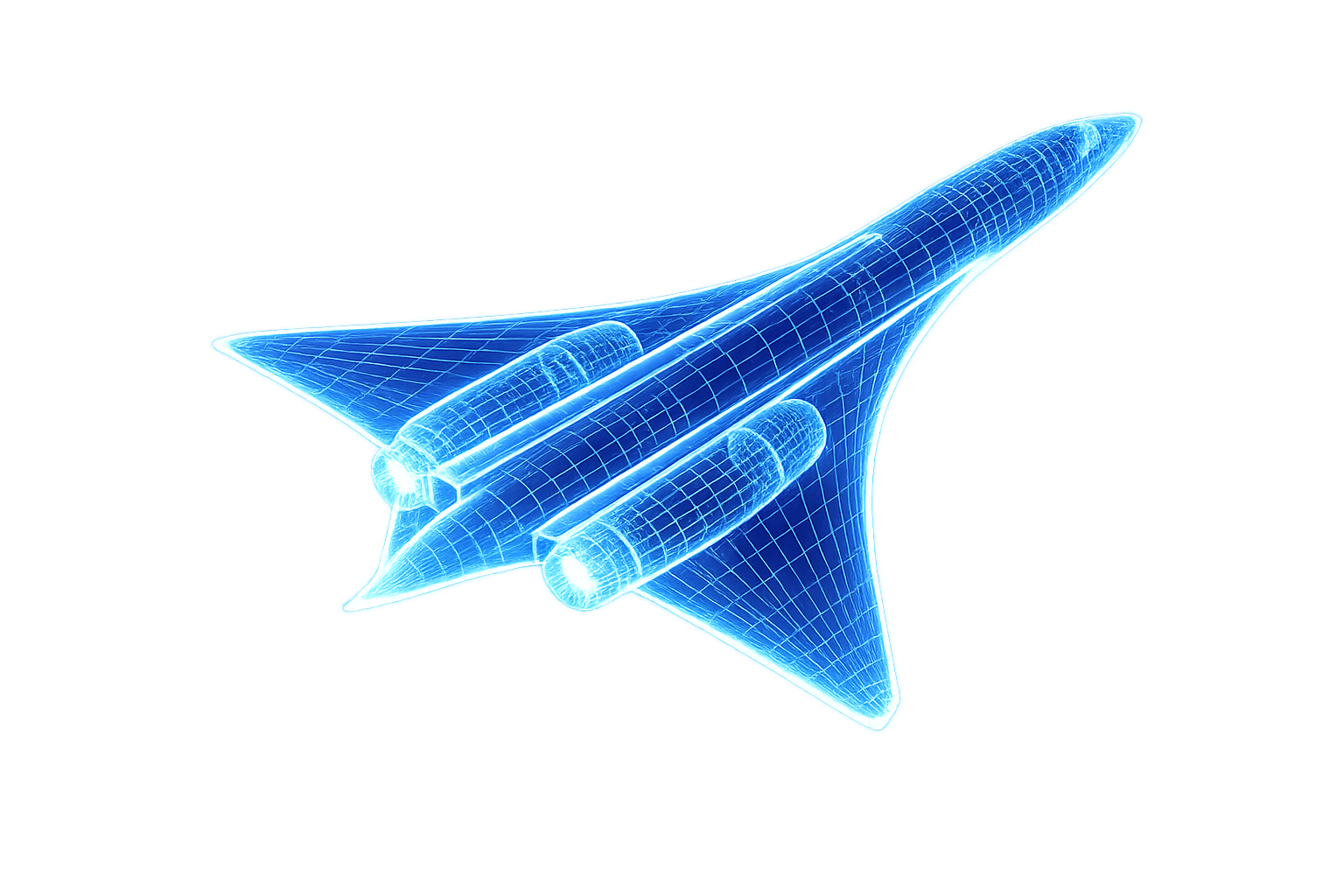
A digital twin is only as credible as the physics it represents. Its foundation must be first principles — not abstraction alone.
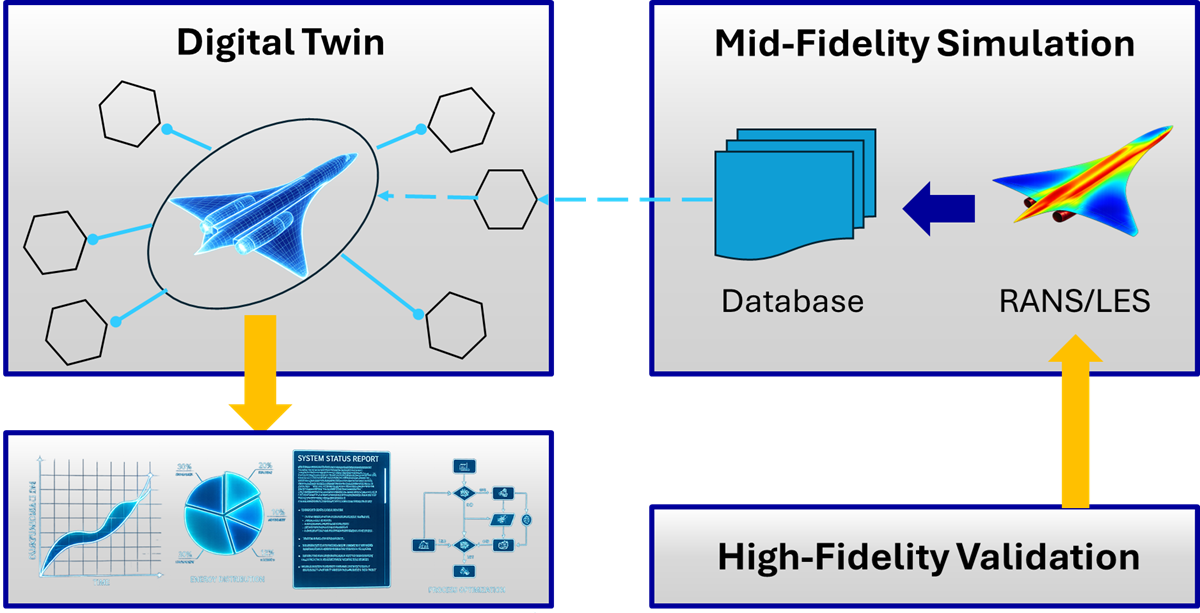
At Volantek, digital twins are built from physics-based, low-fidelity models that capture the dominant multi-physics governing system behavior at the system level. These foundational formulations are informed by mid-fidelity computational databases and selectively strengthened through high-fidelity physics research and validation.
This multi-scale, multi-fidelity architecture improves predictive reliability while preserving computational tractability. The result is a tailored digital twin framework that reflects the true physical behavior of your aerospace system — across disciplines, operating regimes, and mission phases.
Our Digital Twin Architecture…
A digital twin becomes operationally powerful when physics — not data volume — anchors system understanding.
Physics-based digital twins require fewer monitoring points to infer system state, enabling deeper insight with reduced instrumentation and data overhead. This is particularly critical for hypersonic and space systems, where sensing is constrained and uncertainty carries high cost.
Volantek’s digital twin architecture transforms complex, multidisciplinary data into actionable system-level insight, supporting confident decisions across design, integration, test, and operation.
In practice, this enables:
Faster and more defensible design trade studies
Improved payload thermal and performance margins
Better integration compatibility across subsystems
Enhanced operational awareness and control
Real-time decision support and threat recognition
A clearer path toward certification and regulatory confidence
…Delivers Your Competitive Edge
Digital Twin Empowers Next Generation Systems
Independent studies consistently identify physics-based digital twins as a cornerstone of future aerospace development.
“The digital twin paradigm for future NASA and US Air Force vehicles” : According to NASA and the U.S. Air Force (2012), digital twins are expected to fundamentally change certification, fleet management, and sustainment by replacing decades of empirical design margins with physics-based lifecycle understanding—leading to higher reliability and reduced structural inefficiency.
“Digital twin: Definition & value” : According to the AIAA Digital Twin studies (2020), digital twins provide measurable value by accelerating the transition from research to deployed aerospace systems, reducing lifecycle cost, and strengthening global competitiveness through improved decision-making and risk reduction.
“Economics of Digital Twins in Aerospace and Defense” : According to Malone (2024), aerospace and defense represented approximately $1.8 billion of the global digital twin market in 2022, with industry projections reaching nearly $270 billion by 2032, and documented aerospace applications reporting up to a 40% improvement in first-time quality.