
Asymptotes in Hypersonics
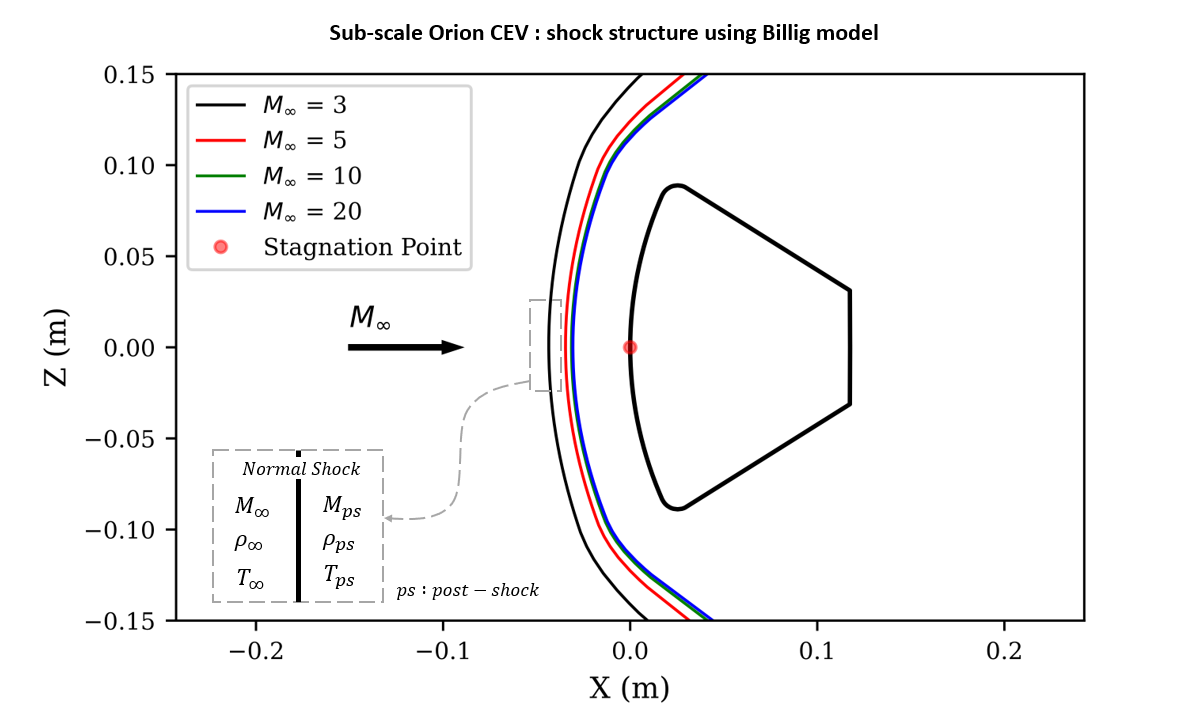
Mach 5 is generally considered the rough bound between supersonics and hypersonics. But why is it so?
Classically, this is attributed to the elevated significance of high-temperature physics. However, a few flow characteristics that asymptote under hypersonic shocks give a different perspective to this answer.
First, the shock structure asymptotes beyond Mach 5. The normal shock stand-off distance, based on the classical Billig spherical shock model, is 14% of its asymptotic value at Mach 5 and 3% at Mach 10 for a given stagnation radius.
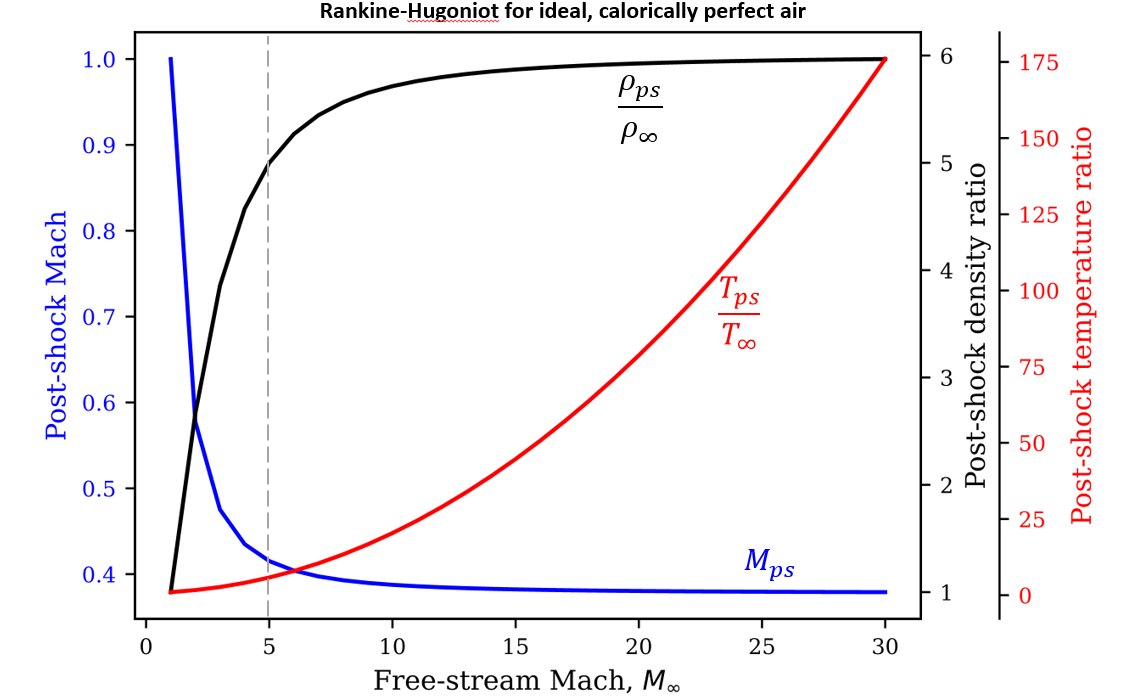
Next, using Rankine-Hugoniot relations for ideal and calorically perfect air, it can be shown that both the post-normal-shock Mach number and the density ratio, or shock compression ratio, asymptote at hypersonic speeds. At freestream Mach 5, the post-normal-shock Mach and density ratio varies 9% and 17% respectively with their corresponding asymptotic values. This asymptotic behavior extends to strong detached shocks, weak oblique shocks and conical shocks.
Why do asymptotes in hypersonics matter?
They influence the aerodynamic and aerothermal loads on a hypersonic vehicle through the Reynolds number. The unit-Reynolds number can be rewritten using Sutherland's law of viscosity, making it a strong function of Mach number and density. The asymptotic nature of the post-shock Mach number and density leads to an asymptotic boundary-layer-edge unit-Reynolds number, and in particular the boundary layer thickness. As a result, a self-similarity is observed in laminar boundary layers downstream of a hypersonic shock. The asymptotes also affect the engine performance through the intake of the propulsion system.
Then why don't the loads asymptote?
Here, the temperature rise plays a critical role. Beyond Mach 5, the Rankine-Hugoniot relations predict a monotonically increasing post-shock temperature ratio, which increases the dynamic viscosity and the heat flux potential over the hypersonic surface. These effects lead to elevated skin friction and thermal loads.
What are the assumptions here?
In real scenarios, air deviates from ideal and calorically perfect gas behavior at about 2000 K, which coincides with the rising significance of enthalpic modes, such as reaction and ionization, in addition to sensible enthalpy at increasingly high temperatures. Note that 2000K corresponds to a post-shock temperature ratio of 8 (at Mach 6) at a freestream temperature of 250 K (at ~40km altitude), which makes the asymptotic behaviour in hypersonic shocks relevant for wide range of Mach and altitude profiles. Viscous effects also influence the shock thickness and minorly affect post-shock fluid properties.
Reference to Billig model: https://lnkd.in/gU8Qv-5y
