
Spatial Aerothermal Loads in Hypersonics
Aerothermal loads ultimately define the operational limits of a hypersonic mission. Vehicle shape, trajectory optimization, material selection, payload placement, thermal management, propulsion efficiency, and component health are all tightly coupled to the spatio-temporal distribution of surface heat flux. Given the multiscale and multiphysics nature of hypersonic systems, first-principles-based low-order models play a critical role in enabling accelerated design cycles and reliable operations. Here, we explore a widely used approach to estimate hypersonic aerothermal loads.
Eckert's Reference Temperature Method (RTM)
Building on last week's hypersonic laminar boundary-layer scaling, skin friction is shown to increase with freestream Mach number as M^(7/6). Using the Chilton–Colburn analogy, the resulting convective heat flux over a hypersonic flat plate exhibits strong dependence on freestream Mach number and the wall-to-freestream temperature ratio.
Eckert introduced a reference temperature at which these dependencies effectively collapse. This temperature represents the near-wall fluid state between recovery and wall temperatures, allowing convective heat transfer to be expressed using a classic Nusselt-number formulation.
What is the relevance of Eckert's RTM ?
Trajectory optimization constrained by aerothermal limits quickly becomes computationally prohibitive when using high-fidelity tools alone. Low-order methods such as Eckert’s RTM can provide fast and surprisingly accurate estimates - sometimes comparable to RANS - for hypersonic heat flux prediction. When integrated into multidisciplinary frameworks, such models enable real-time simulation, trajectory trade studies, and digital-twin-based operational monitoring.
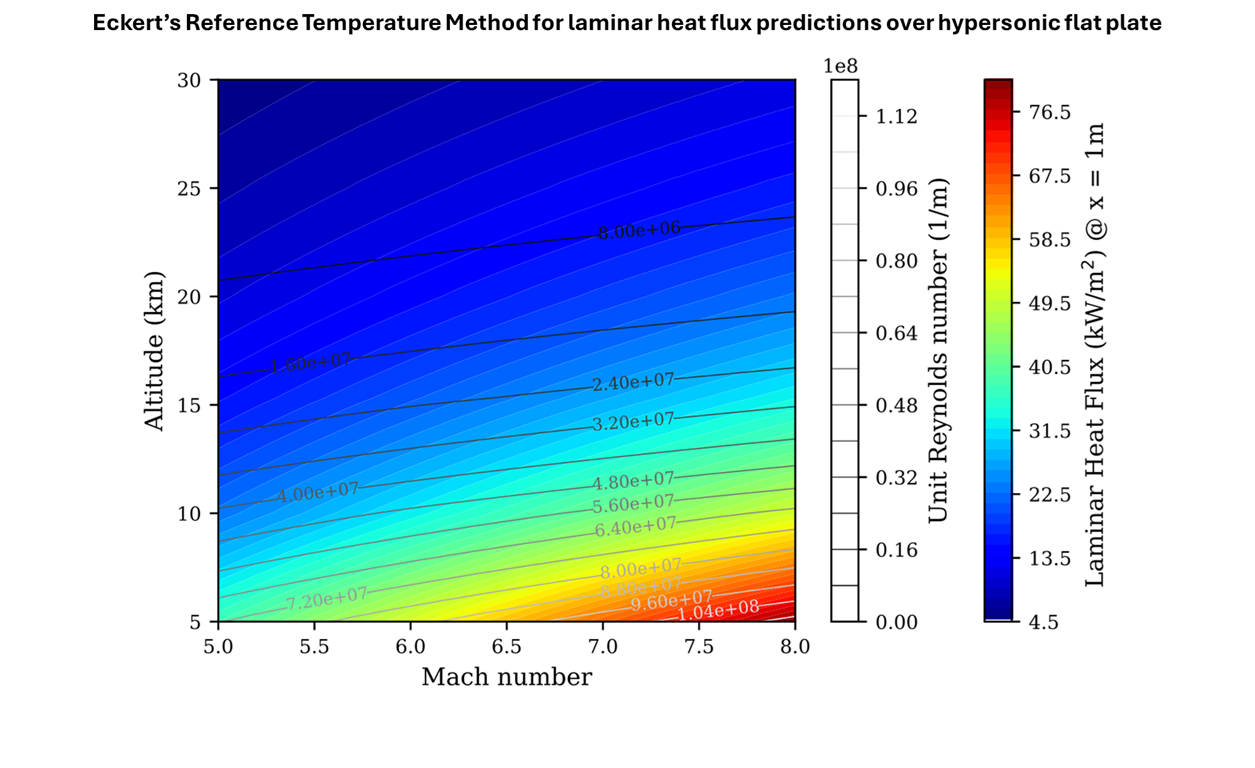
The laminar heat flux at x = 1 m over a flat plate is mapped in altitude–Mach space, illustrating how contour trends directly inform trajectory selection, thermal margins, and payload placement.
How does Eckert's RTM perform on curved geometries ?
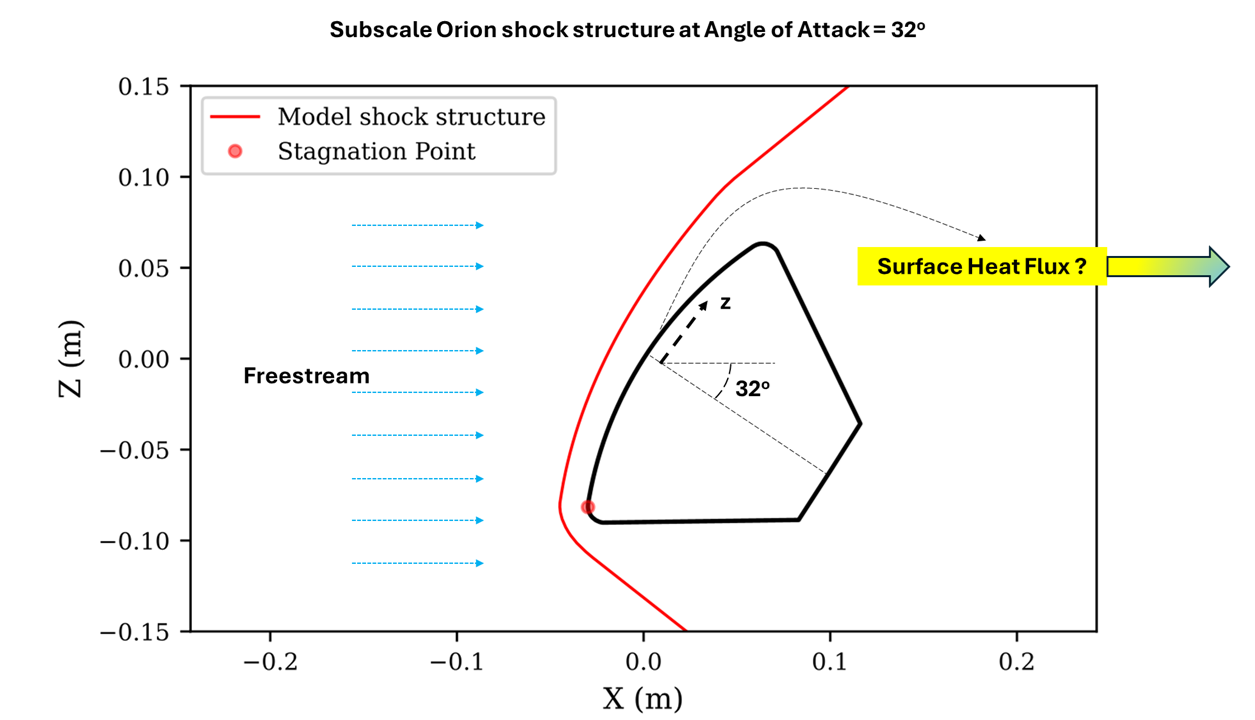
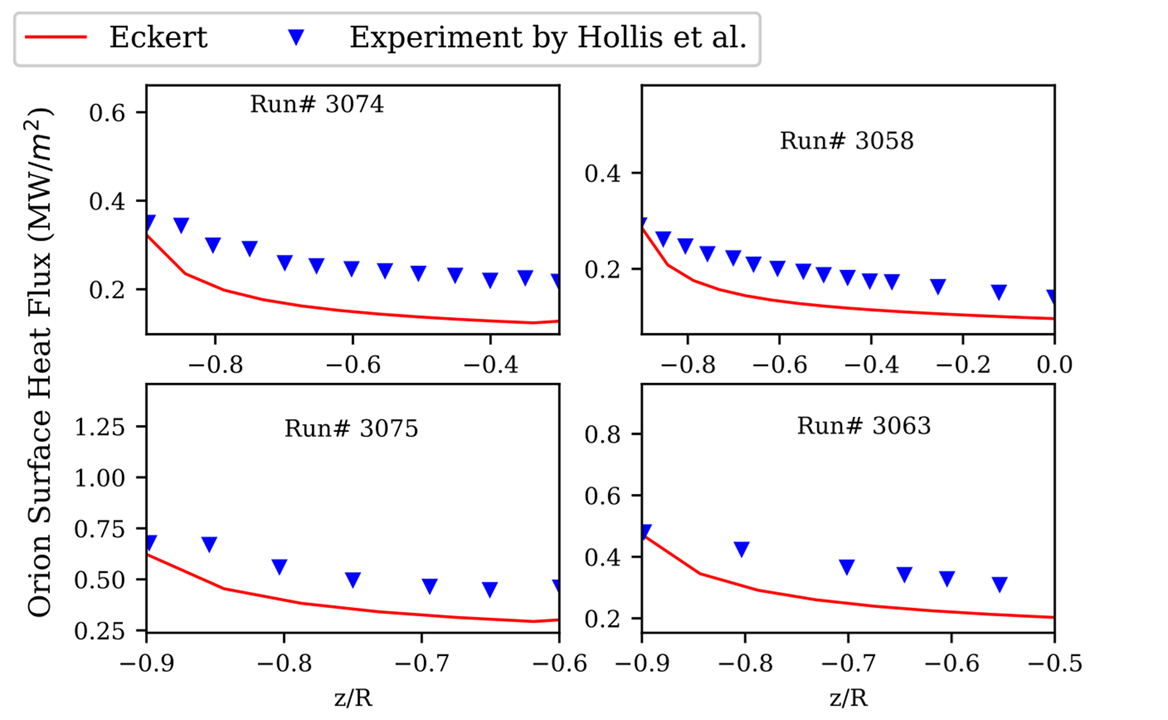
For curved geometries or finite angles of attack, shock-induced changes to boundary-layer edge conditions dominate the aerothermal response. As an example, laminar heat flux over a subscale Orion CEV is estimated by applying post-oblique-shock properties at the boundary-layer edge. This simple approach yields reasonable trends with experimental data reported by Hollis et al.
Next week, we examine low-order modeling of the most critical hypersonic aerothermal load: stagnation heat flux.
References :
Eckert's RTM : Survey on heat transfer at high speeds (1954)
Experiments by Hollis et al : https://lnkd.in/gaejgpmH
