
Hypersonic Shocks and Entropy Layer
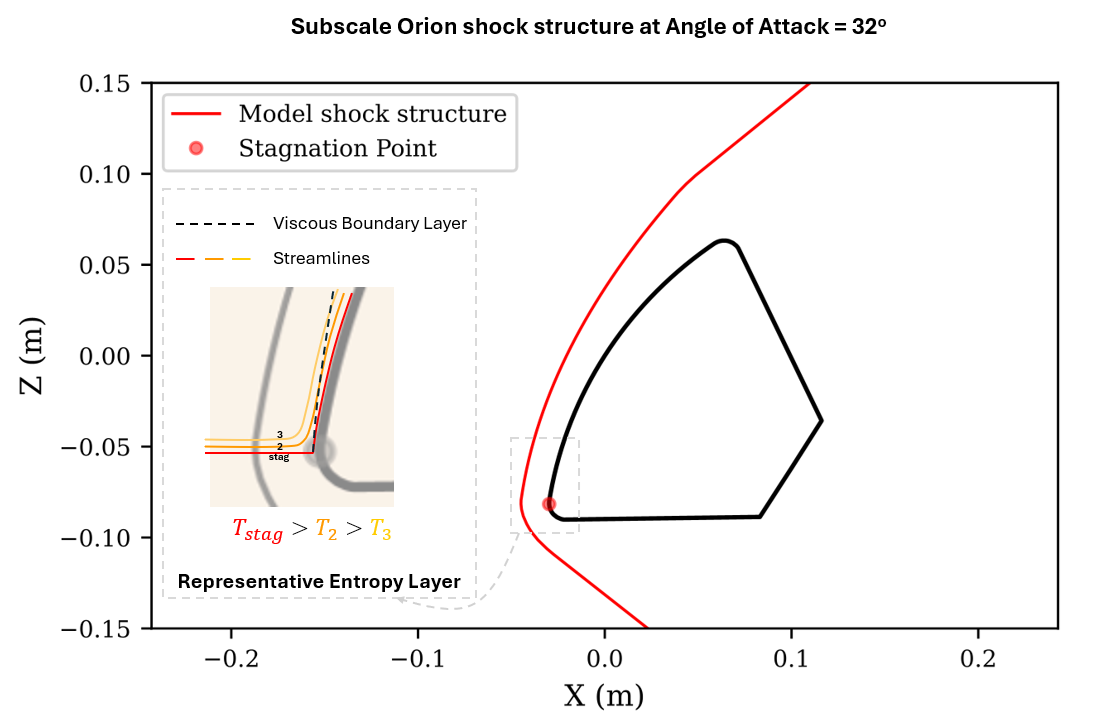
Compression shocks are nature’s mechanism for changing the magnitude and direction of velocity in supersonic and hypersonic flows. Around a blunt-nosed hypersonic body, the flow must decelerate to zero velocity at the stagnation point while satisfying surface impermeability, leading to a curved bow-shock structure. Smaller nose radii result in stronger shocks with reduced standoff distances and enhanced curvature near the stagnation region.
A curved shock produces non-uniform post-shock conditions. The post-shock flow velocity is lowest ahead of the stagnation point and increases continuously along the shock surface. Under ideal-gas assumptions, conservation of total enthalpy implies an opposing trend in post-shock temperature, with the highest temperatures near stagnation and decreasing values along the curved shock. This strong spatial temperature variation is a defining characteristic of hypersonic flows due to their very high total enthalpy.
Formation of the Entropy Layer
Although entropy remains constant along an inviscid streamline downstream of the shock, its value varies across streamlines originating from different locations along the curved shock. This transverse entropy variation gives rise to an entropy layer that persists along the surface of a blunt hypersonic body. According to Crocco’s theorem, entropy gradients contribute to enhanced vorticity in the near-wall region.
The significance of this effect becomes clear when viscosity is considered. Near the stagnation region, the viscous boundary layer develops within this high-vorticity entropy layer, complicating the prediction of wall heat flux. Neglecting entropy-layer effects in stagnation-region heat transfer can lead to errors of tens of percentage points, as seen in the previous post https://lnkd.in/ezrt84qG
Modeling Entropy Layer Effects
Errors associated with entropy-layer modeling primarily arise from underpredicting the boundary-layer edge temperature when post-shock temperature is used directly as the edge condition. A practical correction is to evaluate the entropy or temperature of the streamline located at a height comparable to the viscous boundary-layer thickness. When the viscous boundary layer is immersed within the entropy layer, this approach yields higher edge temperatures and improved wall heat-flux predictions.
As the viscous boundary layer grows downstream and eventually engulfs the entropy layer, the influence of entropy-layer on wall heat flux diminishes. Further along the surface, turbulent boundary-layer effects dominate the flow physics and associated heat transfer.
