
Shock–Shock Interactions in Hypersonics
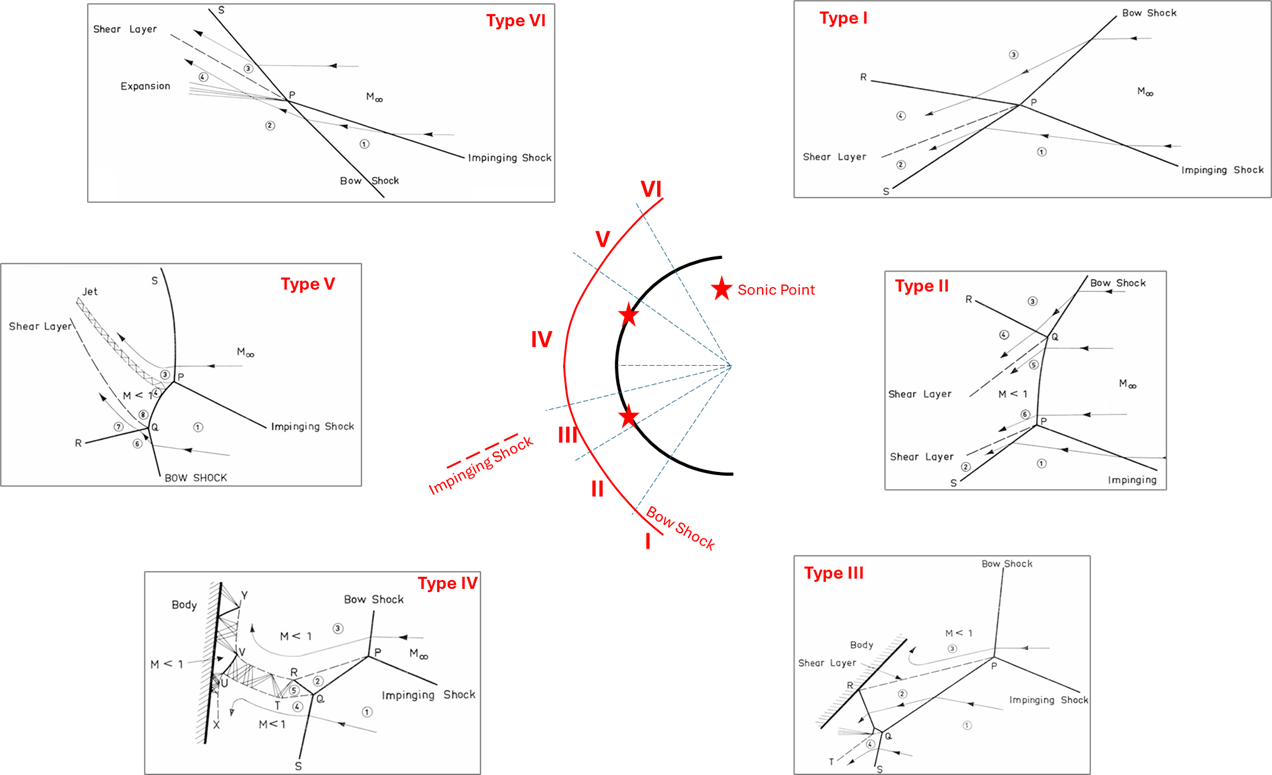
In hypersonic flight, the forebody shock system does not exist in isolation. The compression shocks generated upstream can impinge on the bow shocks formed ahead of other leading edges such as the engine cowl or secondary surfaces. Sometimes this occurs unintentionally. Sometimes it is part of the compression strategy.
When an incident shock intersects the bow shock over a blunt body, the interaction can fall into one of six patterns classified by Barry Edney. The type depends on where along the bow shock the impingement occurs. That location is governed by the sonic line inside the shock layer ahead of the blunt body. The bow shock can therefore be divided into sectors, and each sector corresponds to a different interference topology. A schematic of these sectors and the associated Type I to Type VI patterns is shown in the figure (reference: https://lnkd.in/g53Qhm45).
Implications of Shock-Shock Interactions
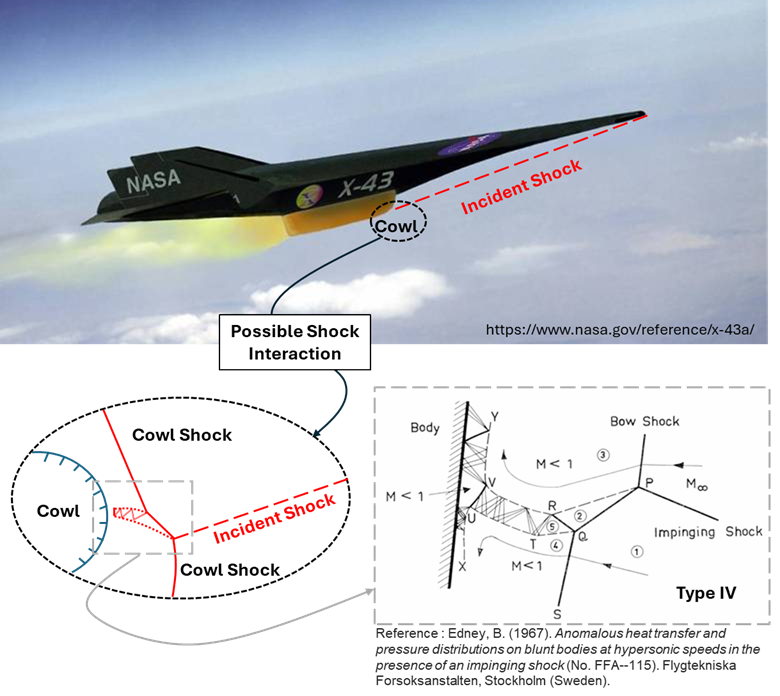
Shock–shock interactions reorganize the entire shock layer. A small change in angle of attack can shift where the incident shock meets the bow shock. That alone can move the flow from one interaction type to another. The transmitted shock structure changes. The local pressure amplification changes. The heat flux distribution changes.
For an airbreathing vehicle, this is not just a local aerothermal issue. It directly affects inlet flow quality and engine operability. Particularly with Type IV interactions, the transmitted shock can induce boundary layer separation and local jet impingement within the shock layer. The associated heat flux amplification can be severe and often becomes a design driver for the cowl leading edge and thermal protection strategy.
The X-43 geometry is shown here only as an illustrative example. The engine cowl is designed as a blunt body to reduce aerodynamic heating, which results in a bow shock ahead of the cowl. If the forebody compression shock intersects the bow shock in the appropriate sector, a Type IV pattern can form ahead of the cowl. The pattern is also tied to the altitude, Mach number, and vehicle attitude. Hence, hypersonic vehicle design becomes a coupled multidisciplinary, multiphysics problem involving trajectory, aerothermodynamics, propulsion, and thermal management.
