
Energy Budget during Hypersonic Re-entry
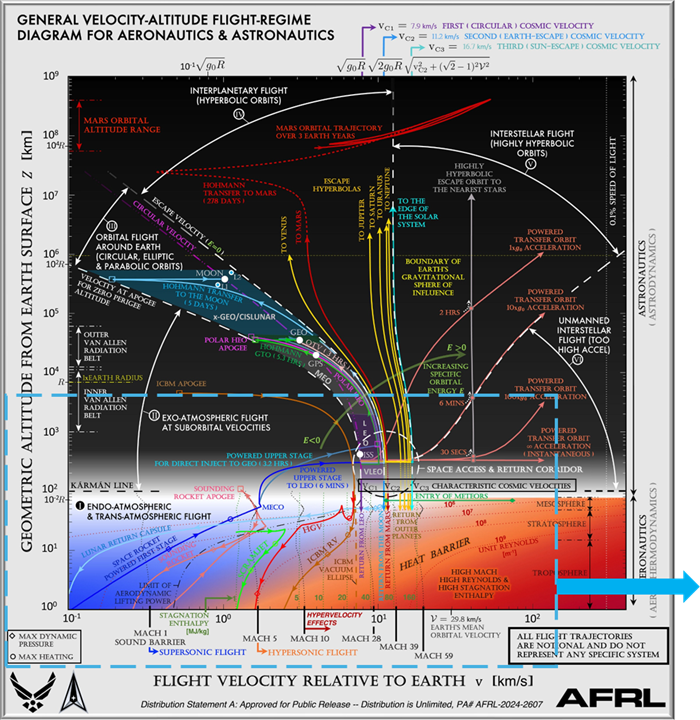
Space missions often encounter hypersonic physics during the re-entry of interplanetary vehicles. The criticality of aerothermal and aerodynamic challenges varies across planetary missions. Vehicles arriving with higher total energy require significant drag, resulting in extreme aerodynamic heating, to safely land on Earth’s surface.
Our recent conjugate aerothermal heat transfer model (https://lnkd.in/eMXgGJb3) shows that approximately 2% of the total energy change of a re-entry vehicle is convected onto its surface; the rest is dissipated into the atmosphere as heat. Close to 90% of this convected heat is radiated off the vehicle surface, while about 10% is conducted through the material; numbers that depend heavily on the material type used. For example, highly insulating materials absorb heat efficiently, leading to higher surface temperatures and increased thermal radiation, thereby reducing internal thermal conduction.
Velocity-Altitude Map & Aerothermodynamics
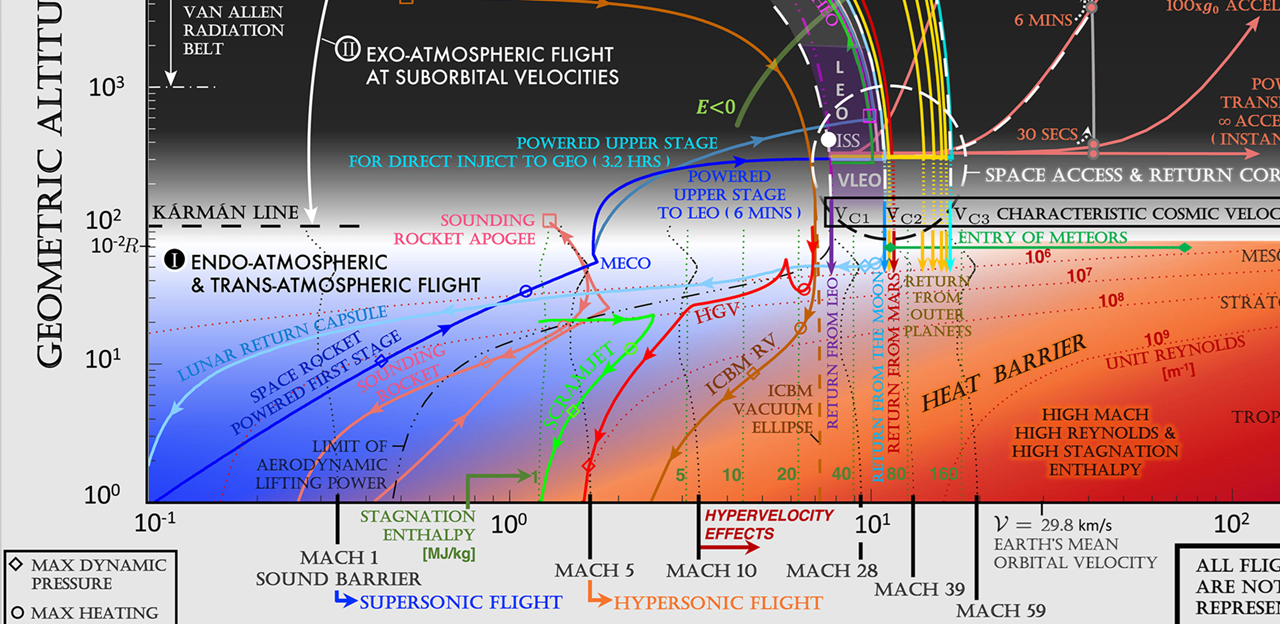
It is critical for aerospace designers to understand the total energy of a re-entry vehicle from a mission standpoint and discern flight regimes based on aerothermal influence. Dr. Javier Urzay has generated a comprehensive velocity–altitude map of general aerospace missions, including all Mach regimes and covering astronautical distances from the Earth’s surface (https://lnkd.in/eZiSSsp7). One key takeaway from this chart is how different the re-entry velocities at the Kármán line (representing total energy) appear across interplanetary missions. The overlay of unit Reynolds number, Mach variation with altitude, and aerodynamic lifting limits depicted in the chart is crucial for system-level understanding of re-entry. The seamless blend of aeronautics and astronautics shown in the chart is key to understanding the role hypersonics plays in connecting both worlds.
Reference : Urzay, J. (2025). "General Velocity-Altitude Flight-Regime Diagram for Aeronautics and Astronautics". Journal of Spacecraft and Rockets, 62(2), 692-695.
