
Space Debris and Hypersonics
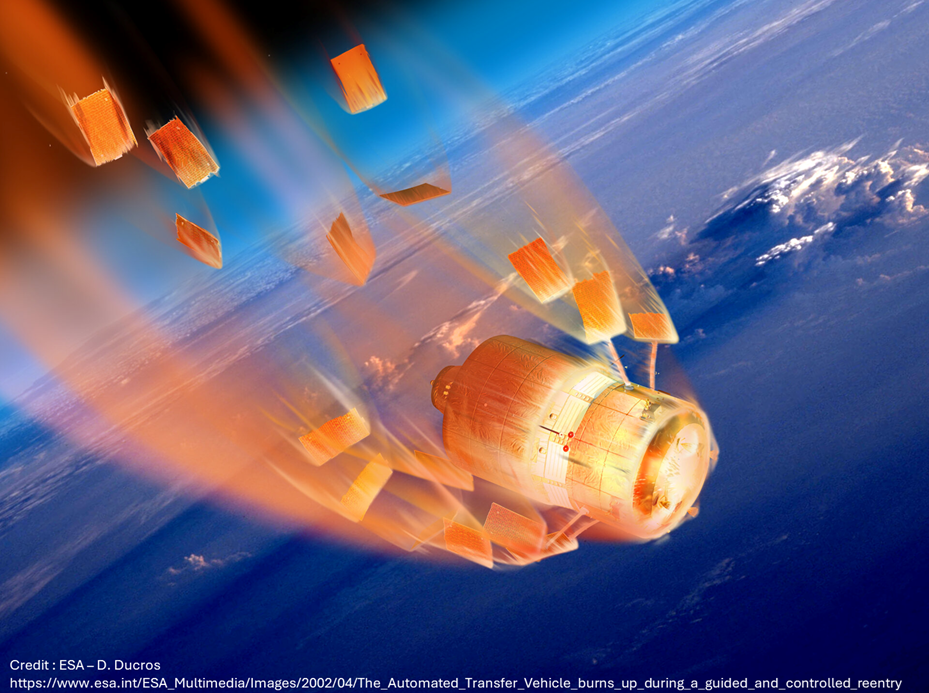
Currently, Earth's orbit contains roughly 15,000 active satellites and over 50,000 trackable objects, including defunct satellites, rocket bodies, and fragmentation debris. By 2030, active satellites alone could exceed 60,000 under conservative projections, with total trackable objects potentially well beyond 100,000.
As these numbers rise, safe debris mitigation becomes a vital problem, and hypersonics sits at the core of the solution.
The most reliable way to remove a defunct satellite in LEO is controlled atmospheric re-entry. At orbital speeds (~7–8 km/s), re-entry occurs deep in the hypersonic regime. Extreme aerothermal loads drive ablation, structural weakening, and fragmentation. Most fragments burn up due to intense convective and radiative heating, leaving oxidized metallic residues. However, denser components — tanks, reaction wheels, titanium structures — can survive and reach the surface.
If the re-entry corridor or breakup physics is poorly characterized, ground risk increases. This is fundamentally a hypersonic aerothermodynamics problem.
Space Debris Re-entry Risk Management
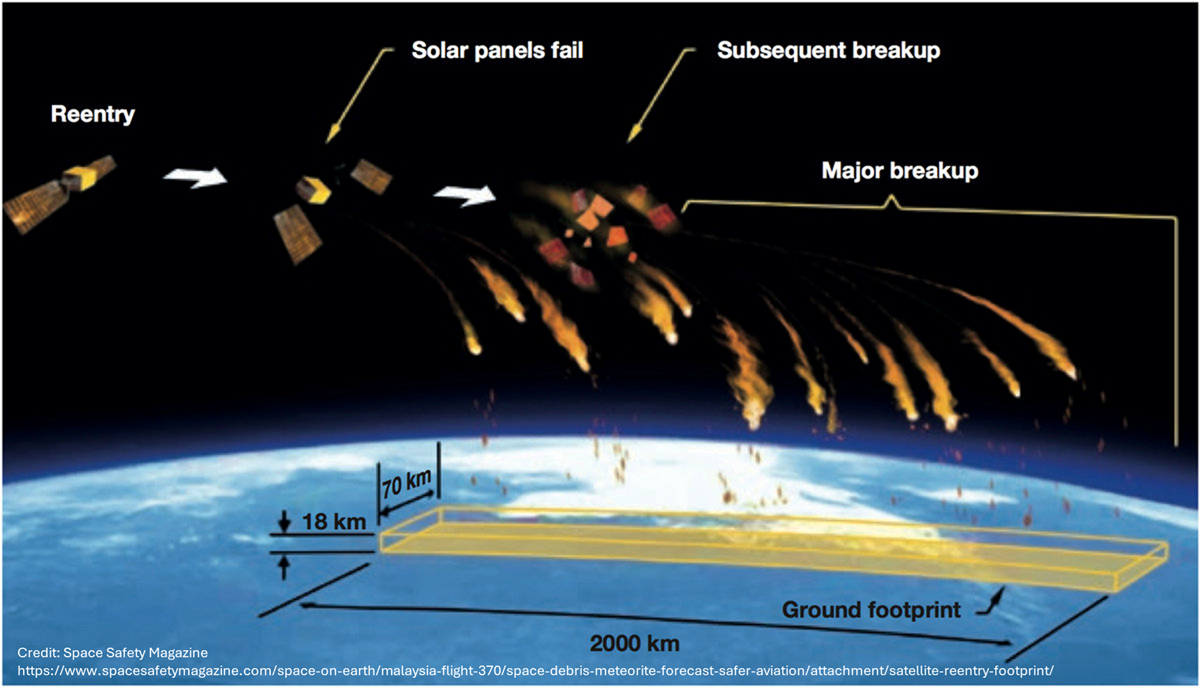
During controlled re-entry, a spacecraft performs a carefully planned retro-burn so that its state parameters at atmospheric interface are well defined. These parameters feed trajectory propagation models with Monte Carlo simulations over breakup altitude, material response, and fragment survivability. Such analyses are performed well before disposal to ensure casualty risk remains within internationally accepted limits.
Design for Demise (D4D) strategies further improve safety by selecting materials and structural layouts that maximize burn-up during hypersonic entry.
In contrast, uncontrolled re-entry introduces uncertainty in entry angle, attitude state, fragmentation sequence, and heating loads. Those uncertainties widen the potential debris footprint and elevate probabilistic ground risk. As satellite density increases, managing this uncertainty becomes increasingly important.
Re-entry Survival Analysis Tools
Existing tools such as ORSAT, DRAMA, and DEBRISK provide important foundations for re-entry survival analysis. In my recently accepted AIAA-JSR paper (https://lnkd.in/eMXgGJb3), we extend this discussion by incorporating enhanced low-order conjugate heat transfer model into re-entry prediction frameworks.
At Volantek, we are building physics-grounded digital capabilities that support D4D strategies, uncertainty-aware re-entry assessment, and defensible risk quantification for the evolving orbital environment. Feel free to reach out if this topic aligns with your work in space systems or debris mitigation.
