
Hypersonic Boundary Layer Transition
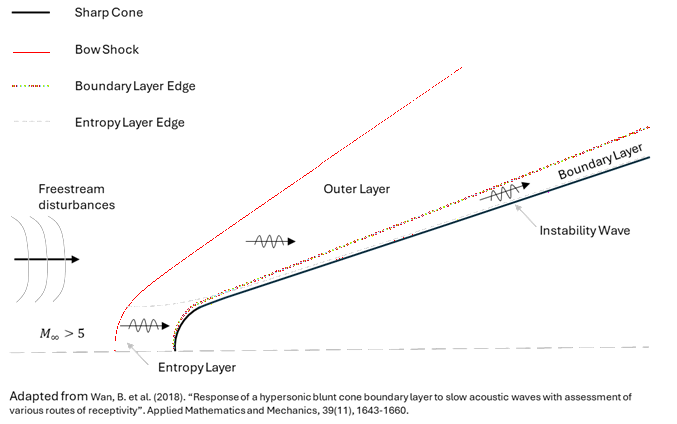
Transition to turbulence in hypersonic boundary layers is not governed by a single mechanism. It emerges from the interaction of instability growth, surface condition, wall temperature, nose bluntness, freestream disturbances, and the local pressure-gradient history of the flow.
In classical fluid mechanics, subsonic boundary-layer transition is often introduced through the amplification of Tollmien–Schlichting waves. As the flow becomes compressible, additional instability families appear. In hypersonic regimes, the most well-known is the Mack second mode — a high-frequency acoustic instability that can dominate the transition process as Mach number increases.
Favorable Pressure Gradient & Relaminarization
Real re-entry vehicles, however, rarely follow this classical picture. Blunt noses reshape the stability problem itself. The detached bow shock generates a strong entropy layer, and the forebody acceleration often produces a strongly favorable pressure gradient along the surface.
This matters because formation of entropy layers and favorable pressure gradients can be stabilizing. The latter result in thinner boundary layers and reduce the amplification of instability waves. Under sufficiently strong acceleration, the boundary layer can resist transition for longer distances, and in some cases even exhibit relaminarization tendencies, especially near rapid flow expansion zones caused by vehicle curvature.
Across speed regimes the physics follows a similar logic, but with different dominant mechanisms. In subsonic flows, favorable pressure gradients suppress Tollmien–Schlichting growth. In supersonic and hypersonic flows, compressibility modifies the instability spectrum, and additional modes such as the Mack second mode, secondary Görtler-type instabilities, or roughness-induced instabilities can compete.
For blunt-nosed re-entry bodies, the transition cannot be interpreted simply as higher heating leading to earlier turbulence. The pressure-gradient profile of the boundary layer can locally delay transition or weaken instability growth, even while the vehicle experiences extreme aerodynamic heating.
This is why hypersonic transition remains such a delicate physics problem. A hypersonic geometry not only shape the flowfield, it also determines which instability mechanisms are allowed to survive.
References:
Mack, L. M. (1990). "On the inviscid acoustic-mode instability of supersonic shear flows: Part 1: Two-dimensional waves". Theoretical and Computational Fluid Dynamics, 2(2), 97-123.
Hollis, Brian, et al. (2008). "Aeroheating testing and predictions for project Orion CEV at turbulent conditions." 46th AIAA Aerospace Sciences Meeting and Exhibit.
Paredes, Pedro, et al. (2020). "Toward transition modeling in a hypersonic boundary layer at flight conditions." AIAA Scitech 2020 Forum.
