
Predicting Hypersonic Boundary Layer Transition
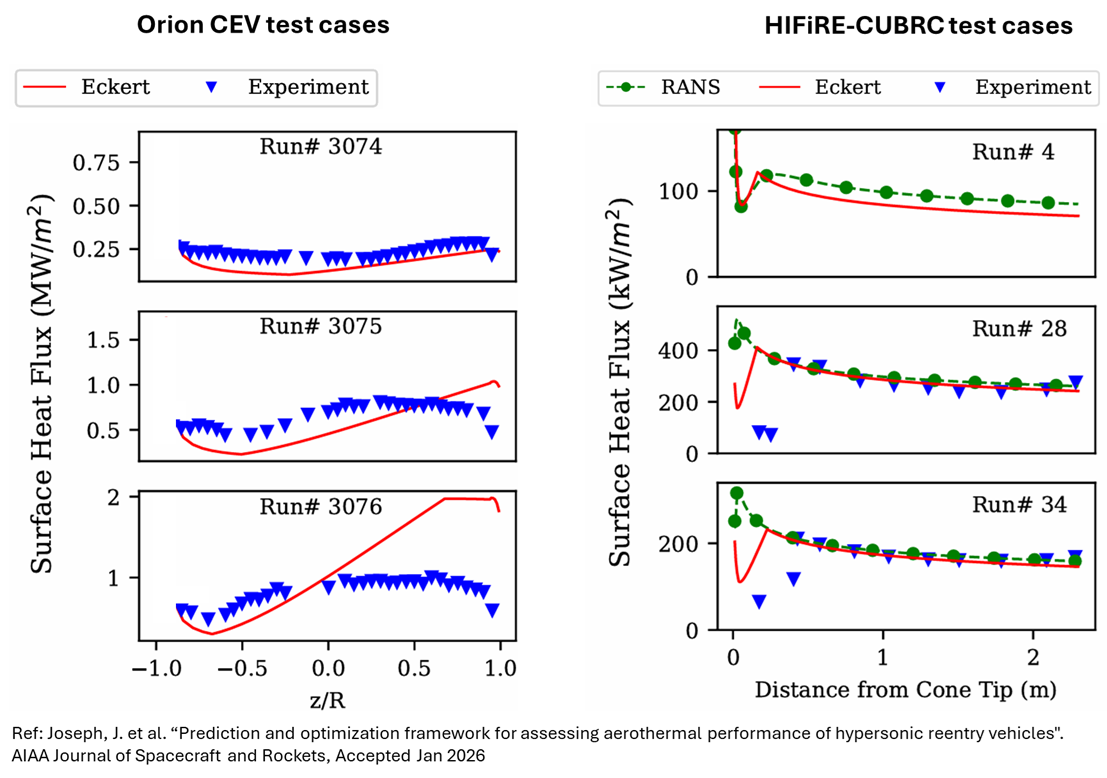
In hypersonic aerothermodynamics, two practical questions matter immediately for assessing boundary layer transition: where it begins, and how long the flow remains transitional before fully turbulent heating is established. Both affect predicted heat load, local heating distribution, and the conservatism built into thermal protection design.
Approximate Models
Approximate prediction methods in the literature usually treat these two questions differently. Transition onset is often correlated using boundary-layer parameters such as momentum-thickness Reynolds number, edge Mach number, local Reynolds number, wall temperature effects, or roughness-based measures. The specific form changes from one method to another because each correlation is calibrated to the dataset from which it was developed. Some are based on cone data, some on flat plates, some on flight-oriented configurations, and some on wind-tunnel measurements. The result is that different criteria can predict different onset locations even for the same flowfield. Hoffmann et al. show that practical engineering methods still rely heavily on empirical correlations built from local boundary-layer quantities rather than a universal transition model.
The extent of the transition region is also not universal. Aeroheating measurements from Orion studies by Hollis et al. show that heating does not jump instantly from laminar to turbulent levels. Instead, there is a finite region over which the heating rises progressively, and this is exactly the region that becomes difficult to represent with a single simple rule.
Re-entry Conditions
This difficulty becomes even more important in re-entry applications. As Prof. J.D. Anderson notes, these correlations are useful mainly because they are better than having no estimate at all. They are not universally valid, they are not based on all the coupled physics involved, and the uncertainty in them is often hard to quantify. That limitation becomes especially important when moving from controlled laboratory conditions to real flight environments.
In my paper, I used a deliberately simple classical model for approximate validation. Transition onset was assumed based on freestream Reynolds number criterion of 5e5. The transition length to full turbulent heat flux was taken as six times the laminar-region length, based on trends observed in the HIFiRE aeroheating results. This was used as a practical approximation for the Orion test case and the HIFiRE flared cone case, with heat transfer evaluated using Eckert's RTM.
References:
Hoffmann et al. : https://lnkd.in/eDeSsqqW
Hollis et al. : https://lnkd.in/gaejgpmH
Prof J.D. Anderson : https://lnkd.in/ebcq8Q_3 (pp. 335-345)
Present paper : https://lnkd.in/eYGtj95A
