
Shock–Boundary Layer Interaction: Incident Shock Impingement
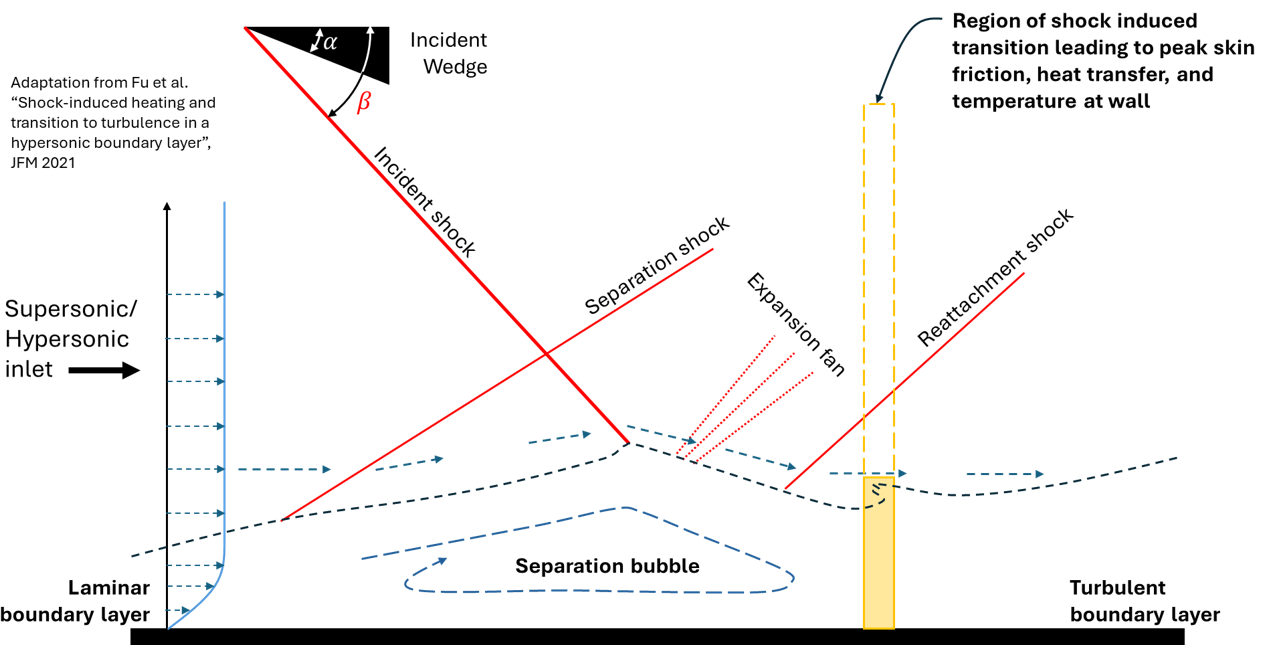
The interaction between an incident shock and a boundary layer is not restricted to hypersonic flows, but its consequences become significantly more severe as Mach number increases. In hypersonic aerothermodynamics, this interaction introduces one of the most critical localized loading mechanisms on a vehicle surface, driven by strong pressure gradients, flow separation, and rapid transition.
Shock Structure and Implication
An incident shock imposes a sudden pressure rise that communicates upstream through the subsonic portion of the boundary layer, leading to separation and the formation of a recirculation region. The separated shear layer is inherently unstable and undergoes rapid breakdown, often triggering transition immediately downstream of the impingement location. This transition is highly localized and does not follow the classical gradual route observed in canonical boundary-layer development. (Ref: Sandham)
The post-interaction region is characterized by sharp overshoots in skin friction and heat transfer. Peak heating is typically observed near the reattachment location, where the combined effects of compression, turbulent mixing, and reattachment produce extreme thermomechanical loads. Both numerical and experimental studies consistently show that these localized peaks can exceed equilibrium turbulent levels, making them a dominant contributor to surface heating. (Ref: Fu et al.)
Implications on Actual Systems
A well-documented flight example highlights the severity of this mechanism. During hypersonic flight of the X-15A-2, shock interaction associated with a ramjet test article impinged on the supporting pylon, leading to intense localized heating that burned through the structure. Additional interactions between the pylon-generated shock and the vehicle surface caused further localized damage, ultimately allowing high-temperature boundary-layer flow to penetrate internal regions. This event clearly demonstrates that shock–boundary layer interaction is not merely a theoretical construct, but a flight-critical phenomenon capable of driving structural failure. (Ref: Anderson)
From a system perspective, such interactions create localized thermal spikes that are not captured by classical boundary-layer assumptions. Transition in these flows is not solely governed by freestream disturbances or surface roughness, but can be directly induced by the interaction itself. As a result, shock–boundary layer interaction remains a primary source of uncertainty in predicting heating loads and designing robust hypersonic systems.
References:
Sandham, N.D. : https://lnkd.in/e6rkFwdM
Fu et al. : https://lnkd.in/e2uSrd4J
Anderson, J.D. : "Hypersonic and High-Temperature Gas Dynamics", 3rd Ed., pp 410-412
