
SERVICE 02 - SPACE DEBRIS
Re-entry is a hypersonic problem.
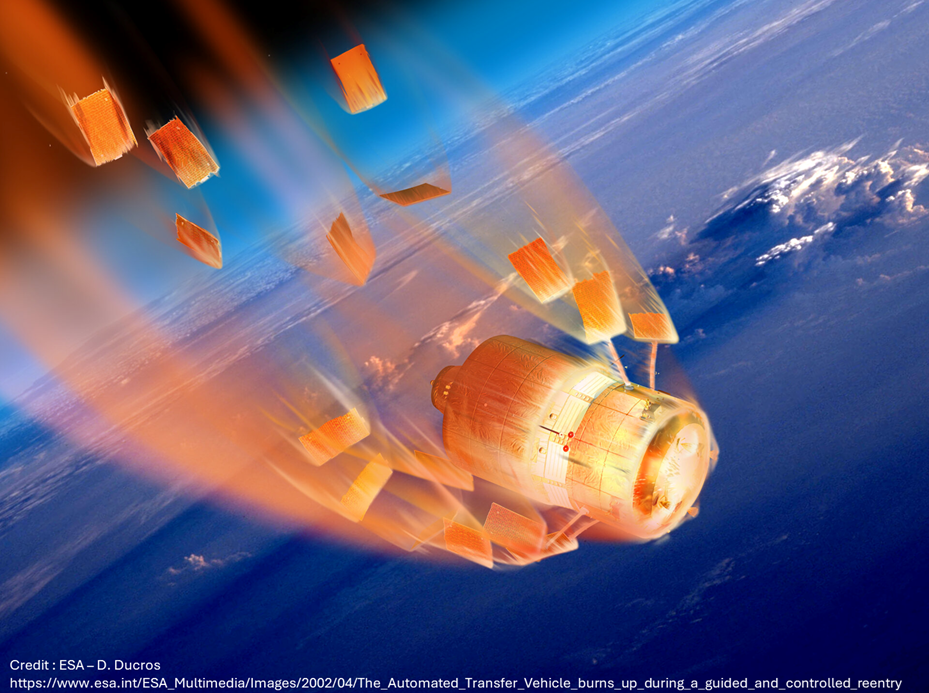
Satellites, rocket bodies and their fragments do not share a single re-entry outcome. Volantek is developing physics-based assessment of trajectory, heating, material response and uncertainty to support re-entry analysis and Design for Demise.
OBJECTS IN SCOPE
Whole objects. Components. Fragments.
Satellites & payloads
Spacecraft, satellite structures and payload components returning through the atmosphere.
Rocket bodies & hardware
Discarded rocket bodies, components and mission-related objects assessed as re-entering debris.
Fragmentation debris
Payload and rocket fragments whose properties, entry conditions and thermal response can be uncertain.
WHY THIS MATTERS
More re-entries. More consequential questions.
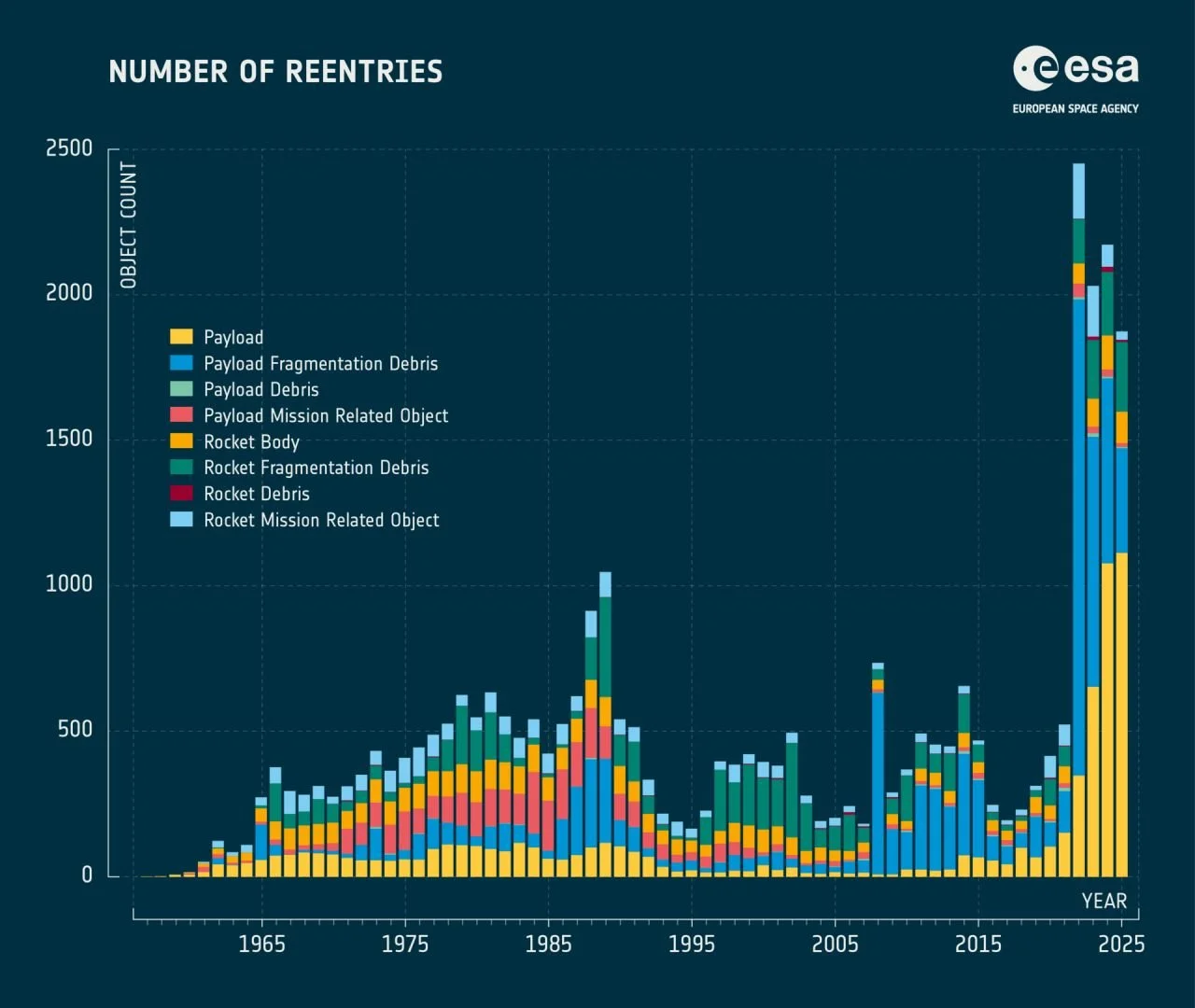
Source: ESA, Space Environment Report 2026. Original supplied figure; colours and data retained.
ESA’s 2026 Space Environment Report records more than three intact satellites or rocket bodies re-entering each day on average and introduces an on-ground casualty-risk metric. Increasing traffic makes transparent re-entry assessment more important.
The chart includes multiple object types and excludes human spaceflight. Object counts are not counts of surviving fragments or ground impacts.
A SCOPED ASSESSMENT
Make the unknowns explicit.
01
Define the object
Record what is known about mass, geometry, materials, attitude and entry state. Bound the properties that remain uncertain.
02
Compare physical outcomes
Use the applicable trajectory, aerothermal and thermal-response models to explore representative cases and sensitivities.
03
Support the decision
Document dominant uncertainties, design implications and the evidence needed to improve confidence.
DEVELOPMENT FOCUS
From entry physics to debris consequences.
Available foundation
Coupled re-entry trajectory, aerothermal loading and thermal response.
Research comparisons against flight, test and reference cases.
Parameter studies and uncertainty/sensitivity foundations.
Application development
Object-specific assessment of heating and material response for debris cases.
Debris-specific benchmark cases, breakup models and component survival evaluation.
Survival, consequence and footprint uncertainty appropriate to the agreed model scope.
Breakup, fragment survival and impact footprints require application-specific development and validation. We define those requirements with the customer before treating outputs as decision-ready.
WHO THIS SUPPORTS
Earlier design decisions. Clearer re-entry assessments.
Spacecraft manufacturers
Compare materials and component choices through a Design for Demise study.
Operators & SDA providers
Explore how uncertain object properties affect atmospheric-entry forecasts and consequence assessment.
Government & prime teams
Define a reproducible assessment method and evidence base for a scoped prototype.
Need thermal and lifecycle modelling beyond re-entry? Explore Digital Twin →
WORK WITH VOLANTEK
Start with the object and the uncertainty.
Discuss a re-entry study, a Design for Demise question or a partner-led assessment prototype.
+1 647 451 5645