
SERVICE 01 - HYPERSONICS
Physical insight for high-speed decisions.
Connect high-speed object behaviour to the thermal and aerodynamic limits that govern it. Volantek brings coupled re-entry physics to engineering studies and the development of defence surveillance decision support.
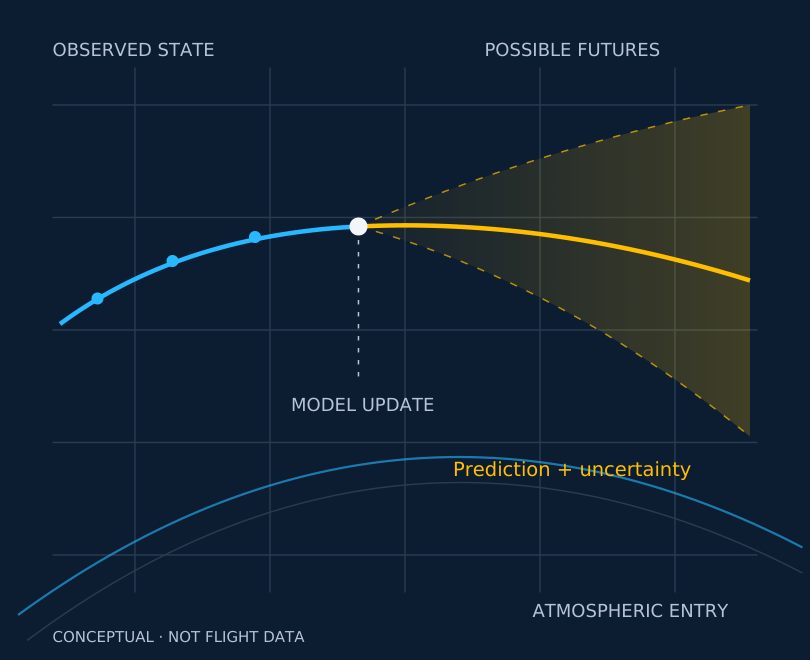
TWO CONNECTED APPLICATIONS
Engineering depth. Operational relevance.
Surveillance decision support
Develop physical-feasibility and uncertainty assessments from partner-supplied tracking outputs. Explore candidate future trajectories, thermal constraints and the consequences of uncertain object properties.
Vehicle and payload assessment
Evaluate how geometry, mission profile, aerodynamic heating and internal heat transfer interact. Compare design choices and identify the variables that most affect thermal margins.
SCOPE AN ENGINEERING STUDY
Questions we can work on
Trajectory & aerodynamics
How do entry conditions and aerodynamic properties change the path, loads and timing?
Aerothermal loads
Where do peak and accumulated heating occur, and which flight conditions drive them?
Thermal response
How do materials, heat transfer and payload placement influence temperature histories?
Typical study outputs: model definition, selected scenario comparisons, sensitivity results, documented limitations and a technical review of the decision being supported.
PUBLISHED FOUNDATION
Built on coupled physics and reference evidence.
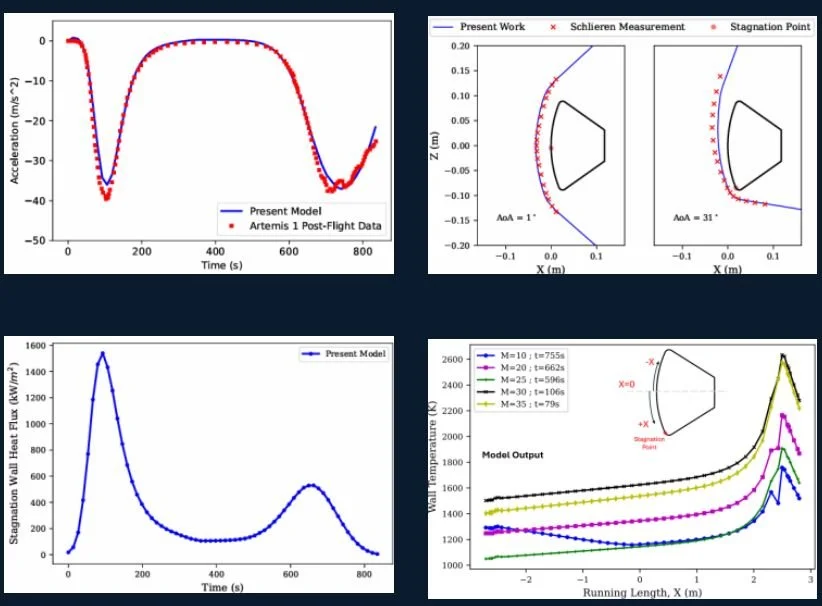
NASA Orion / Artemis I
Trajectory and aerothermal reference comparisons.
View technical paper ↗
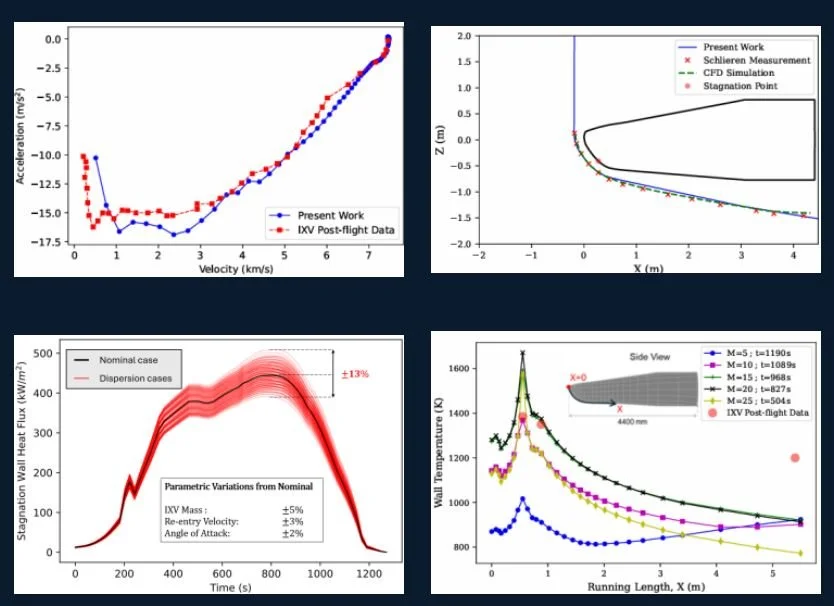
ESA IXV
Re-entry, shock-structure and thermal-response comparisons.
View technical paper ↗
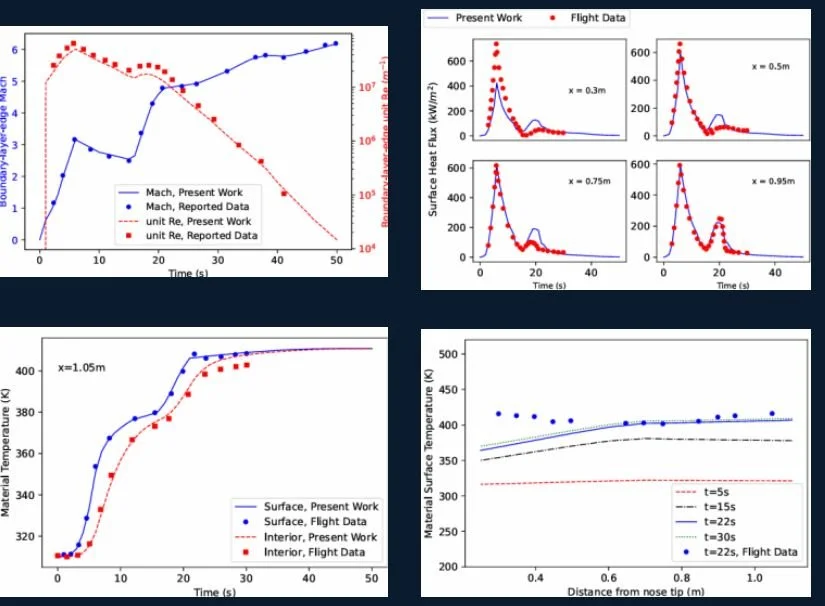
AFRL HIFiRE-1
Flight and test comparisons of high-speed thermal response
View technical paper ↗
Selected research comparisons with flight, test and reference data. Applicability and validation limits are specific to each model and case.
UVAD CONNECTION
A technical link worth following.
PEER-REVIEWED JOURNAL · 2026
The re-entry research was co-authored with UVAD’s Dr. Ryan Whitside and the University of Waterloo’s Dr. Jean-Pierre Hickey. UVAD’s January 2026 news item links to this Hypersonics page.
Read UVAD’s research announcement ↗
Prediction and Optimization Framework for Assessing Aerothermal Performance of Hypersonic Reentry Vehicles
AIAA Journal of Spacecraft and Rockets. Jeswin Joseph, Ryan Whitside and Jean-Pierre Hickey.
DOI: 10.2514/1.A36485 ↗
AIAA CONFERENCE PAPER · 2026
HIFiRE-1 Flight Assessment Using MARSHAL
Multiphysics Architecture for Real-time Simulation of High-speed Aerothermodynamic Loads. Jeswin Joseph, Ryan Whitside and Jean-Pierre Hickey.
DOI: 10.2514/6.2026-5069 ↗
INTEGRATION DIRECTION
From state estimates to feasible futures.
For defence surveillance applications, the proposed next step is to connect the existing physics foundation to refreshed states, covariance and candidate object hypotheses.
— Agree the input state, reference frame and uncertainty.
— Select representative cases and performance questions.
— Compare predictions against agreed evidence.
— Develop a documented interface for the partner workflow.
System-level latency, threat classification and operational deployment are evaluated within the integrated programme.
WORK WITH VOLANTEK
Bring a case. Define the decision.
Start with a vehicle, reference trajectory or representative unclassified surveillance scenario.
+1 647 451 5645