
SERVICE 03 · DIGITAL TWIN
An architecture for the full lifecycle.
Connect vehicle design, test evidence and operational data through a physics-based digital representation. Volantek develops reduced-order and multi-fidelity model architectures around the engineering decisions your team needs to make.
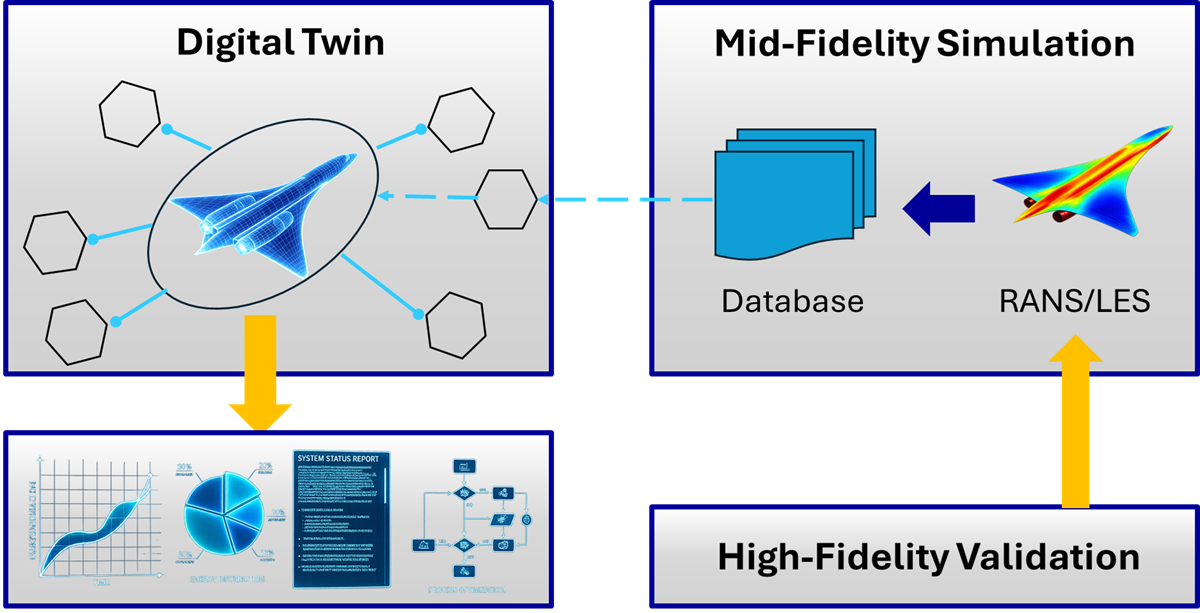
Conceptual multi-fidelity model architecture.
DESIGN → TEST → OPERATION
Keep the physical model connected to the system.
01
Design & integration
Compare configurations, operating envelopes and thermal interfaces. Identify the design variables that govern performance and payload margins.
02
Test & model refinement
Compare predictions with measurements, assess discrepancies and establish where the model is trustworthy.
03
Operational support
Define how suitable telemetry or state estimates can update the model and support health, performance and mission assessment.
ENGINEERING WORK PACKAGES
Useful well before a full operational twin.
Thermal and payload models
Reduced-order thermal networks, transient heat-transfer models and coupled external/internal environments for vehicle or payload studies.
Multi-fidelity modelling
Use first-principles models for rapid exploration, informed by selected CFD or higher-fidelity reference cases where they add value.
Integration definition
Specify inputs, outputs, update logic and evaluation cases for a model that will sit inside your engineering or operational workflow.
Sensitivity and uncertainty
Identify which unknown properties and operating conditions drive the result. Preserve the basis for each comparison.
RELEVANT DEVELOPMENT EXPERIENCE
ATHENS: aircraft thermal modelling.
During his work with UVAD, Jeswin developed the Aircraft THermal Environment Simulator (ATHENS), a modular low-order aircraft thermal digital twin. This experience informs Volantek’s approach to thermal networks, coupled prediction and practical engineering models.
ATHENS was developed for UVAD; it is presented as founder experience, not as a Volantek-owned product for sale.
Explore Jeswin’s background →
BEYOND ONE APPLICATION
Vehicle, payload and system insight.
— Transient thermal response
— Payload placement and thermal margins
— Subsystem heat-transfer coupling
— Mission and operating-condition trades
— Model comparison with test evidence
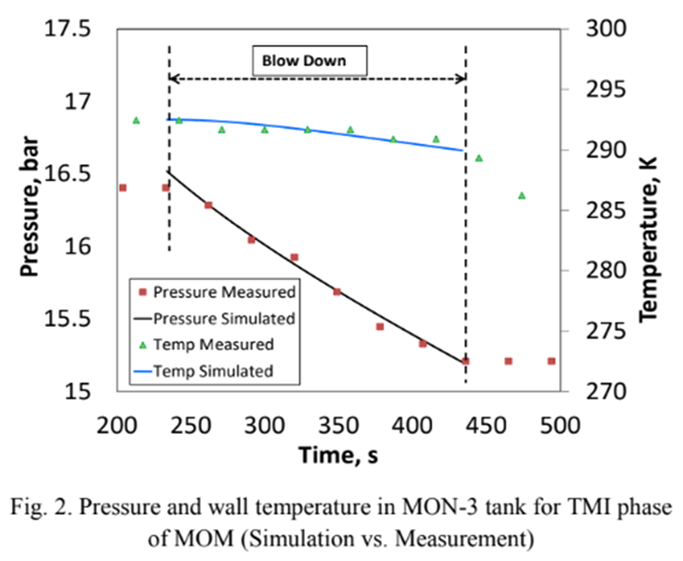
Pressure and temperature comparison from Mars Orbiter Mission thermodynamics work. Founder’s prior research experience.
ENGINEERING HERITAGE
Model behaviour against measurements.
Jeswin’s earlier spacecraft thermodynamics work connects system-level models with measured pressure and temperature histories. That discipline carries into model definition, validation and the interpretation of uncertainties.
Read the referenced work ↗
HOW A PROJECT STARTS
Define a decision before building a twin.
SCOPE
Decision & evidence
Agree the system boundary, available data, model questions and success criteria.
BUILD
Model & evaluate
Develop the selected physics, compare with reference cases and report uncertainty.
TRANSFER
Review & integrate
Deliver documented models and outputs, with an integration path appropriate to the project.
WORK WITH VOLANTEK
What would a useful digital twin help you decide?
Start with a thermal problem, a vehicle design trade or a model you need to connect to your workflow.
+1 647 451 5645